
Barcode Scanners Are Smarter Than Ever — Here's What to Know

Updated: Mar 26
The humble barcode scanner has come a long way from its early days at grocery store checkouts. Today, it sits at the intersection of automation, artificial intelligence, and real-time data management — and the businesses that choose the right one are gaining measurable advantages over those that don't. Whether you're a retailer optimizing your checkout line, a warehouse manager tracking thousands of SKUs, or a healthcare provider scanning patient wristbands, understanding the modern barcode scanner landscape is no longer optional. It's a competitive necessity.
This guide breaks down everything you need to know — from technology types and real-world applications to smart buying advice — so you can confidently find the best barcode scanners for your operation.
Why Barcode Scanners Matter More Than Ever in 2025
The numbers tell a compelling story. The global barcode scanner market is projected to grow from USD 8.4 billion in 2025 to USD 15.8 billion by 2035, reflecting a compound annual growth rate of 6.5% — driven by sustained demand for advanced scanning technologies that enable real-time data capture and seamless process automation.
This growth isn't happening in a vacuum. Global utilization of barcode technology has significantly increased between 2024 and 2025, with approximately 90% of major retailers now incorporating barcodes into their inventory and sales systems. In other words, if your business isn't already leveraging a reliable barcode reader, your competitors almost certainly are.
Beyond retail, the rise of e-commerce, smart warehousing, and healthcare digitization has created demand for faster, smarter, and more durable scanning solutions. AI decoding and smart vision technology now allow imaging scanners to read damaged, curved, or low-contrast barcodes — improving speed and reducing error rates across logistics and manufacturing.
Breaking Down Barcode Scanner Types: Which One Is Right for You?
Not every barcode scanner machine is built the same. Understanding the core technology categories helps you match the right device to your environment.
Laser Scanners: Fast, Reliable, and Time-Tested
The laser scanner remains a staple in retail and light industrial settings. It works by projecting a beam of light across a barcode and reading the reflected pattern — a proven method that delivers speed and precision at an affordable price point. Laser scanners continue to lead the market, valued for their accuracy, reliability, and cost-effectiveness across retail and industrial operations.
However, a laser scanner is limited to reading 1D barcodes — the traditional striped format seen on most packaged goods. For businesses that only process standard linear codes in clean, well-lit environments, this is still an excellent choice.
1D Barcode Scanners vs. 2D Barcode Scanners
A 1D barcode scanner reads standard linear codes quickly and is widely compatible with legacy POS and inventory systems. It's the right call for straightforward retail or shipping label workflows where simplicity matters more than versatility.
A 2D barcode scanner, by contrast, captures a full image of the code rather than sweeping a beam across it. This rapid adoption of 2D barcode readers is driven by the increasing demand for fast, efficient, and accurate product identification, inventory management, and customer engagement. Critically, a 2D barcode scanner doubles as a QR code scanner — capable of reading QR codes from mobile screens, loyalty cards, event tickets, and digital menus. Two-dimensional barcodes are gaining significant traction in the market, representing an emerging trend that offers enhanced data capture capabilities and improved efficiency across multiple sectors.
If you're building or upgrading a system today, the 2D barcode scanner is almost always the smarter long-term investment.
Handheld Barcode Scanners
Handheld scanners dominate the product landscape, accounting for 55% of the market in 2025, thanks to their mobility, ease of integration, and compatibility with emerging technologies such as RFID and smartphone-based scanning.
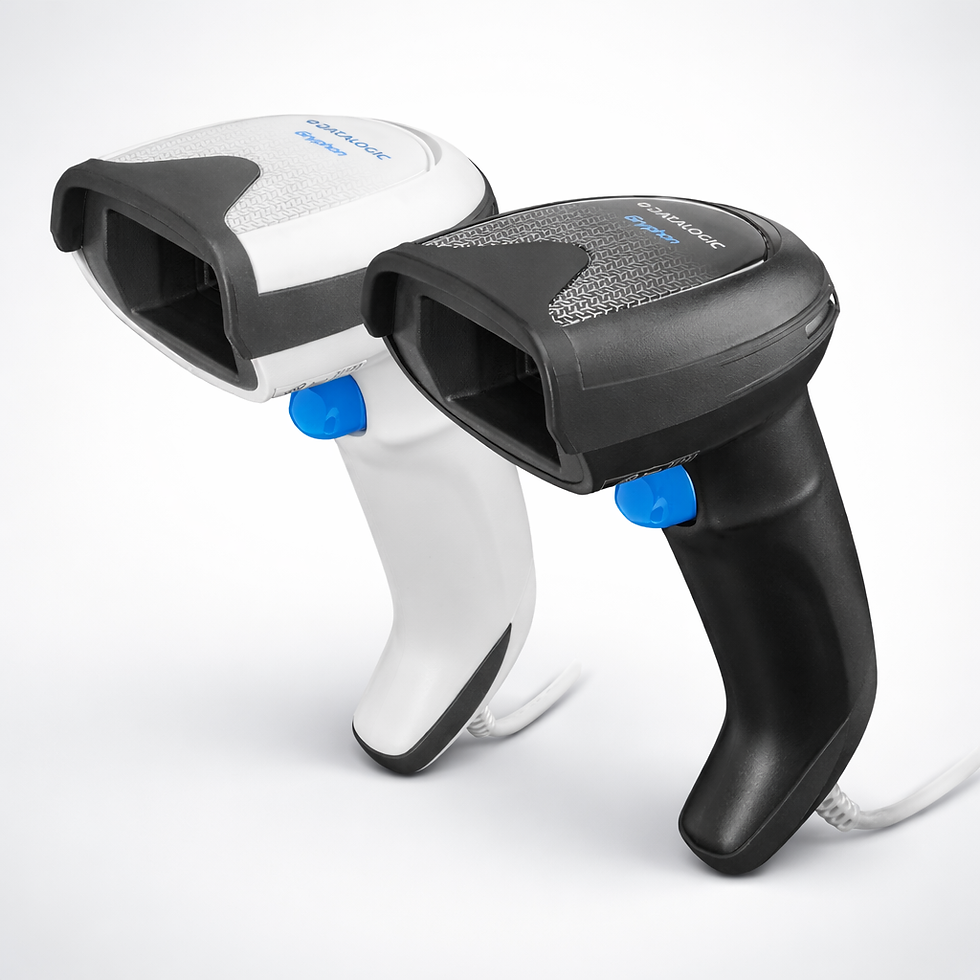
A handheld scanner is the most versatile option for most businesses. Available in both corded and cordless configurations, handheld barcode scanners work across retail counters, stockrooms, loading docks, and healthcare environments. Staff can be trained on them in minutes, and they integrate cleanly with most POS and ERP platforms.
Wireless Barcode Scanners
For operations where movement is constant, a wireless barcode scanner — or wireless scanner — is indispensable. Using Bluetooth or Wi-Fi connectivity, these devices give staff the freedom to roam warehouse aisles, scan items on shelves, or process returns on the shop floor without being tethered to a cable. The incorporation of advanced features such as wireless connectivity enhances data management capabilities and makes these scanners increasingly attractive to businesses with dynamic, mobile workflows.
Battery life is the primary consideration with any wireless scanner. High-volume operations should target models rated for a full eight-to-twelve-hour shift with fast charging support.
Real-World Use Cases: Where Barcode Scanners Drive the Biggest Impact
Retail and POS Environments
POS barcode scanners are engineered specifically for checkout speed and reliability. Presentation scanners sit on the counter and read items as they pass — no trigger required — while handheld models handle everything from price checks to returns. Retail stores and supermarkets are increasingly adopting these devices to speed up transactions, scanning multiple items faster even with damaged or poorly printed barcodes.
Warehousing and Logistics
This is where wireless barcode scanners and rugged handheld devices truly shine. The warehousing and logistics segment accounts for an estimated 35–40% of the global barcode scanning engine market — driven by rising demand for efficient warehouse management systems and supply chain optimization. Workers scanning inbound shipments, picking orders, and updating inventory levels depend on fast, accurate scanning that doesn't slow the line.
Healthcare
In hospitals and pharmacies, a barcode reader is a patient safety tool. Medication verification, lab sample tracking, and patient wristband scanning all depend on fast, error-free scanning. Hospitals and pharmacies use handheld readers for medication tracking and patient identification, where precision is not just a convenience — it's a regulatory requirement.
Manufacturing and Quality Control
Direct Part Marking (DPM) technology is fueling new demand for imagers that can read tiny, worn, or curved barcodes in manufacturing environments. Fixed-mount scanners on production lines and rugged handheld units used by floor staff help manufacturers maintain traceability at every stage of assembly.
Events and Ticketing
A QR scanner or 2D barcode scanner has become the standard tool at concerts, sporting events, and conferences. Scanning digital tickets from mobile screens instantly, at high speed and in variable lighting, requires a capable area imager — not an older laser-only device.
Key Features to Evaluate Before You Buy Barcode Scanners
When you're browsing barcode scanners for sale, the product listing can feel like a sea of specs. Here's what actually matters:
Scan Engine: Choose between a laser scanner for 1D-only environments, a linear CCD imager for improved tolerance of damaged codes, or a 2D area imager for maximum versatility including QR code scanning. The 2D imager is the safest choice for most modern businesses.
Connectivity Options: USB wired connections suit fixed workstations perfectly. Bluetooth wireless scanners pair with tablets and mobile POS terminals, while Wi-Fi models are better suited for real-time syncing in large facilities.
Durability and Build Quality: Check for IP ratings (dust and water resistance) and drop-test certifications. Manufacturers are increasingly focused on sustainable design — using low-energy components, recyclable materials, and longer product lifecycles — without sacrificing durability in demanding environments.
Software and System Compatibility: Ensure the scanner works natively with your existing POS, warehouse management system (WMS), or ERP software. Many modern models support plug-and-play USB HID mode, making setup almost instant.
AI and Smart Decoding: Organizations implementing AI in their barcode scanning processes can expect significant increases in operational efficiency and meaningful reductions in scanning errors— a compelling reason to consider next-generation models with intelligent decoding capabilities.
Buying Considerations: Matching Your Budget to Your Needs
Finding the right scanner isn't just about features — it's about matching capability to context.
Small retailers and startups getting their first POS barcode scanner will find that an entry-level corded 2D handheld scanner covers nearly every scenario without overspending. Many reliable models are available at accessible price points that deliver professional-grade accuracy.
Growing businesses and multi-site operators benefit most from wireless barcode scanners with cloud sync capability, enabling centralized inventory visibility across locations.
Enterprises, logistics providers, and manufacturers should seriously evaluate rugged Android-based handhelds that function as full mobile computers — scanning, processing, and transmitting data from a single device. Android barcode scanners and mobile computers make deployment faster and easier by integrating directly with retail and warehouse management systems.
When comparing barcode scanners for sale from different vendors, always factor in warranty terms, replacement part availability, and the quality of technical support — especially for mission-critical environments where downtime carries real costs.
Conclusion: Invest in the Scanner That Grows With Your Business
A great barcode scanner is one of the highest-ROI investments a business can make. It eliminates manual entry errors, accelerates transactions, improves inventory accuracy, and gives your team tools they can trust shift after shift. Whether you need a lightweight handheld scanner for a boutique retail counter, robust wireless barcode scanners for a distribution center, or a QR scanner that handles both printed and digital codes, the right choice always comes down to matching technology to your real-world workflow.
The market is evolving fast — AI-enhanced decoding, Android-powered smart handhelds, and seamless cloud integration are no longer future concepts. They're available today, at increasingly competitive price points.
Ready to upgrade your operations? Explore the full range of barcode scanners available from leading vendors, request demos for shortlisted models on POS Central UK. The right barcode scanner doesn't just scan — it keeps your entire business moving.
Read more:


Comments